Backyard ultra crew: how to help without burning out
What the crew does between loops, what to bring to base camp and how to look after your backyard ultra runner without wearing yourself out too.
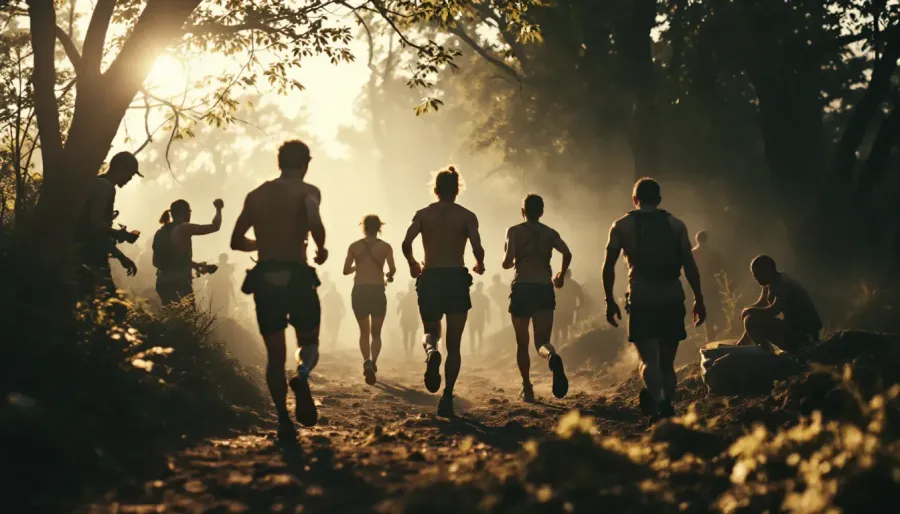
The crew is the person (or the small team) who sets up and runs a runner’s base camp for the whole backyard: food, drink, dry clothes, feet and morale. They always help at camp, between loops — never on the course or running alongside. Understanding that boundary is 90% of doing it well.
What the crew can do (and what it can’t)
The golden rule fits in one sentence: all aid happens at base camp, between loops; nothing happens on the course. According to the Big’s Backyard Ultra rules, aid to the runner is only allowed in the start and finish area, and no pacers are allowed to accompany the runner during the loop.
In practice, this means:
- Allowed at camp: giving them food and drink, helping them change, checking their feet, waking them from a micro-nap, having their chair and kit ready, cheering them on.
- Forbidden on the course: running alongside setting the pace, handing them food or drink on the move, or simply accompanying them “just for a couple of loops” with the best of intentions. Any help there puts their place in the race at risk.
If you have doubts about a specific case (a stretch shared with spectators, for example), each race’s organiser is the one who decides; the crew doesn’t interpret the rules on its own. If you want to understand why the format is so strict about this, we explain it in what a backyard ultra is.
The loop window: what to do between arrivals
Each loop (a “yard”) lasts exactly one hour, and the time the runner has between arriving and having to head out again is whatever is left after completing the course within that margin: early in the race there may be several minutes of rest, but that window narrows over the hours and can shrink to barely 5-10 minutes when the pace gets tight against the limit. Short or long, that time splits into two very different halves for the crew.
Before they arrive, prepare what they’re going to need: a drink that’s already cool (or hot, at night) and food unwrapped and in portions, ready to eat without them having to think. Have everything set up about two minutes before they appear at camp — every second you save here is real rest for them.
When they arrive, spend the first few minutes looking after them in a set order: first get them seated, then food and drink, and finally check whatever may be going wrong (wet socks, a hot spot on the foot, chafing). Don’t overload them with questions or decisions the moment they sit down; give them a moment before asking anything.
Setting up base camp
An organised camp is half the crew’s job. The less there is to look for or improvise, the faster the transitions and the more real rest the runner gets on every loop. The minimum kit list for base camp — lighting, dry warm layers, a chair, food split by loop and a written plan of what’s due on each one — is as useful for the crew as for the runner: in fact, the crew is who will use it most in real time. That written plan can come from the lap plan: one row per loop with its start time and what’s due on it. And if the runner sends it to you as a link, you open it on your phone and tick off loops as the race goes on.
Organise the space so that everything is visible and to hand: clothes for the next loop already folded, two bottles (one in use, another being refilled) and food in portions that don’t need opening in a hurry.
Food and feet, the two fronts that win (or lose) the race
As a rough guide, a backyard runner needs between 200 and 300 kcal per hour, split between easy-to-digest solid food at the start and more liquid or hot food as the night goes on. The crew doesn’t decide what the runner eats — that’s planned before the race — but it is the one that has it ready, on time and without the runner having to think about it. The guide to eating and drinking at camp is the reference worth having taken on board before race day, so you don’t improvise with the clock running.
The second front is the feet. Although the crew isn’t the one who decides the treatment, it is the one who can spot in time a wet sock or a hot spot that the runner, already tired, overlooks. Having the basics of foot and blister care to hand saves loops spent limping later on.
The mental side takes two
Once the first hours have passed, the runner’s biggest enemy stops being the body and becomes the head: the moment when, sitting in the chair, getting up for one more loop seems impossible. There, the crew’s role is to support, not to decide for them. The guide to mental management in a backyard is clear on this: if the runner agreed in advance not to quit during a low patch, the crew’s job is to remind them of that rule, feed them and send them off to the next bell — without negotiating, without pressuring and without promising them anything about the result.
It’s a fine line. Nobody decides for the runner whether they carry on or stop; the crew only keeps one bad hour, on its own, from making that decision for them.
Looking after the crew: shifts, sleep and not burning out
The crew also holds out for many hours in a row, often on their feet and at night, and how well they perform matters: an exhausted crew prepares food worse, forgets things and argues with the runner just when it’s least helpful.
- If there’s more than one of you, set up shifts. Someone can sleep while another covers the small-hours loops, and rotating every long stretch (for example, every 6-8 hours) keeps both heads fresh.
- Sleep when you can, not when it’s “time to”. A short nap between loops, even just 20 minutes, does more than staying awake out of pride.
- Eat and drink yourself too. It’s easy to forget about yourself while looking after someone else; a dehydrated or unfed crew helps nobody after a certain hour.
- Have an emergency backup. If you’re on your own, make clear who you can count on if a real break is needed.
Warning signs: when to alert the organiser
The crew doesn’t replace the race’s medical support. If you notice confusion that doesn’t improve with eating or resting, difficulty breathing, pain that gets worse with every loop or any sign that genuinely worries you, alert the medical staff or the organiser — don’t try to sort it out yourself or wait for the next loop to decide. They have the judgement and the means to assess it; you have the context of the last few hours, so share it in detail when you alert them.
First steps if you’re crewing for the first time
If it’s your first time, this is the minimum so you don’t arrive lost:
- Talk to your runner before the race: what they eat and drink on each loop, what to do if they ask to stop, and what instructions they’ve given for a low patch.
- Learn the loop window and practise setting out the food and clothing kit in a few minutes, before they arrive.
- Bring your own warm kit, food and rest gear — you’ll be out as many hours as they are.
- If there are several of you, split the shifts in advance, not halfway through the race.
- Go over that specific race’s aid rules together, so you don’t take for granted what you did at another one.
If your runner is still working out the pace and the rest window they’ll be able to afford loop by loop, the backyard pace calculator helps them estimate it before race day — and helps you know, more or less, how much real margin you’ll be working with at camp. If they’re also looking for a tailored preparation plan, they can talk to a coach specialising in ultra-distance running.
Frequently asked questions
What does a crew do in a backyard ultra?
It prepares and manages everything the runner needs at base camp between one loop and the next: food, drink, dry clothes, foot checks and encouragement. It doesn't run with them or step in on the course; its whole job happens at the chair, in the rest window between two starts.
Can I accompany my runner in a backyard ultra?
Yes, as crew at base camp: you can be at their side, help them eat and change, and cheer them on between loops. What you can't do is run with them on the course or act as a pacer; they always face that part alone, and helping them there puts their place in the race at risk.
How many people do you need as crew in a backyard?
There is no fixed number. One person can handle the first hours without any trouble, but the more loops the race lasts, the more you need to take turns to sleep and eat. If you expect many hours in a row, two people taking turns hold up better than one person with no rest.
What happens if the crew isn't ready when the runner finishes the loop?
The runner loses part of their rest sorting out alone what the crew should have had ready, and that time can't be won back: the bell rings on the hour regardless. It isn't a disqualification, but it is wasted recovery margin that shows loops later.
Does the crew need to register for the race?
It depends on the organiser: many backyards ask for the support team to be accredited so they can access the camp area, even though they aren't competing. It's worth confirming it with each race's organiser in advance, because there is no single rule for all of them.
Backyards on the calendar
Races on record in Spain, with their history of editions and upcoming dates.
- Backyard Alcañiz Memorial Rafa Esteruelas · Teruel
- Backyard Aranjuez – Only One Race · Madrid
- Backyard Baltasara · Asturias
- Backyard Borja's Extreme Xàtiva · Valencia
- Backyard Cayón · Cantabria
- Backyard Costa Brava Palamós · Girona
Full directory of backyards →Backyard ultra calendar for Spain →
Related guides



What if you prepared for it with a tailored plan?
We adapt the content of this guide to your race, your level and your schedule.